Use functions
On the Advanced Filter's User Filter Definition screen, Operand 2 offers a range of Functions, based on the data type you selected in Operand 1. For example:
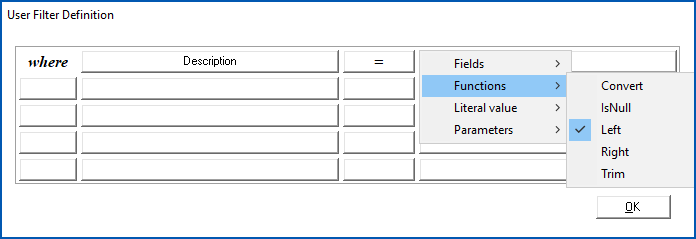
Then, when you select a function in Operand 2, EmpowerHR displays the Define Function Parameters... for that selected function. For example, if you select the Left function to filter by the left-most characters, you define the String and Length function parameters:
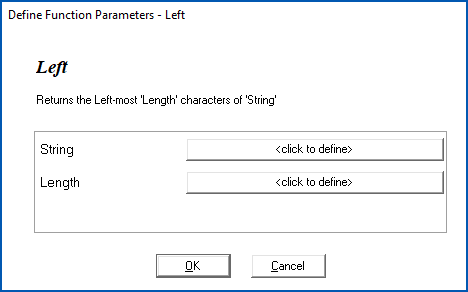
Click a button on the Define Function Parameters... screen. EmpowerHR displays the available options for the particular parameter.
Use literal values
When defining an advanced filter, you can enter a Literal value as a static parameter. However, where you're likely to want to change the value at runtime, we recommend you use a Parameter option rather than a literal value.
For example, when you specify a Literal value for Employment Status (e), the filter restricts the selected data to employees. This means you must modify the query to enable selection of non-employees. Whereas, if you use a Parameter instead, you can select either employees or non-employees by simply responding to the prompt EmpowerHR displays at runtime.
You are only prompted for a literal type that corresponds to the data type you select in Operand 1. In the following example where Annual Salary is a money data type (Annual Salary), you can only select the Money literal definition.
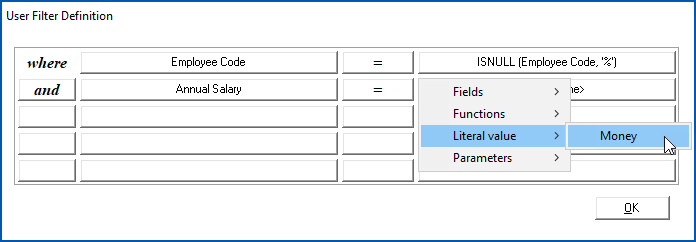
After you click Money, EmpowerHR prompts you to enter a literal value, Money Value.
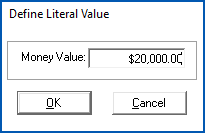
EmpowerHR displays the amount in Operand 2 and encloses the amount in quotes to indicate it is a literal value, like this: '$20,000'
Use parameters
Parameters are similar to Literal values but, rather than entering a value when creating the query, EmpowerHR prompts you to enter the value when you run the query.
Use a standard parameter
To use a standard parameter, in Operand 2, click Parameters, and then select a parameter from the list. For example:
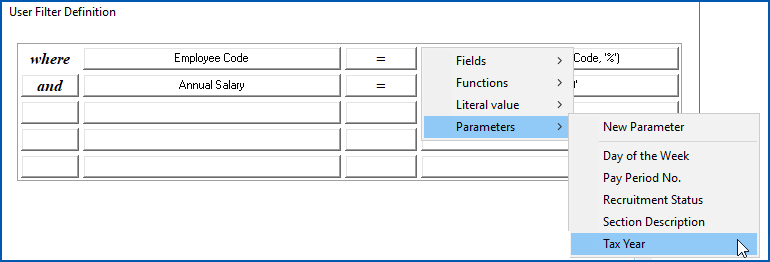
Once you make a selection, EmpowerHR displays the parameter in Operand 2 and encloses it in parentheses to indicate it is a parameter definition, like this: &(Tax Year)
Create a new parameter
If no standard parameter meets the query condition you need, you can create a new parameter.
To create a new parameter:
- In Operand 2, click Parameters, and then select New Parameter.
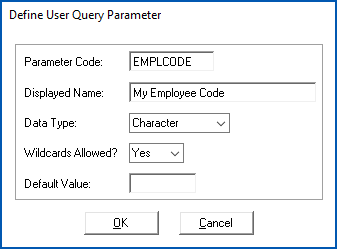
- EmpowerHR displays the Define User Query Parameter screen.
- Enter the definition details using the following table as a guide.
| At this field... | Do this... | ||
|---|---|---|---|
Parameter Code | Enter a unique parameter code. Do not use a leading $ (dollar sign). EmpowerHR uses the leading $ to identify in-built parameters. | ||
Displayed Name | Enter a name for the parameter. EmpowerHR uses this text to prompt the user at query runtime. | ||
Data Type | Select the parameter's data type.
| ||
Wildcards Allowed? | EmpowerHR enables this option if you select character as the Data Type. Select this option to allow wild-card text matching (for example Bill Blog%) so when you use the parameter together with the Operator, like or not like, you can use wildcards. | ||
Default Value | EmpowerHR loads this value by default when prompting you for parameter inputs. |

- Click OK. EmpowerHR displays the parameter in Operand 2 and encloses it in parentheses to indicate it is a parameter definition, like this: &(EMPLCODE)
© 2023 Fusion5. All rights reserved.